Get Free Ebook Monsoon: The Indian Ocean and the Future of American Power, by Robert D. Kaplan
Asking why? You have actually seen that this site contains terrific publications from alternative releases a libraries on the planet. Getting a limited version book is likewise simple right here. You can find Monsoon: The Indian Ocean And The Future Of American Power, By Robert D. Kaplan, as instance to be your turn and also your choice currently. Since, we will certainly not hide anything concerning it right here. We offer you all the best from Monsoon: The Indian Ocean And The Future Of American Power, By Robert D. Kaplan that the author developed particularly for you.
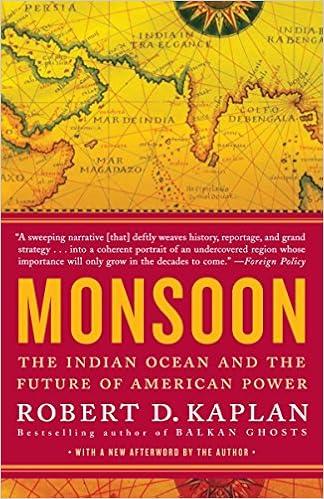
Monsoon: The Indian Ocean and the Future of American Power, by Robert D. Kaplan

Get Free Ebook Monsoon: The Indian Ocean and the Future of American Power, by Robert D. Kaplan
There are several pointers that individuals provide to boost the life top quality, about everything. Right here, we also will supply you a really simple pointer to life much better. Checking out Monsoon: The Indian Ocean And The Future Of American Power, By Robert D. Kaplan is our pointer. Please ask why we suggest this book to review. Many people aim to make themselves to be rich, yet at some time they ignore a very easy point. Reading is in fact a simple point, but numerous are lazy to do it. It's sort of monotonous task as well as waste the time.
The various other intriguing publications could be varieties. You can find them in likewise attractive title. However, what make you attracted to pick Monsoon: The Indian Ocean And The Future Of American Power, By Robert D. Kaplan is that it has various style as stated. The language belongs to be the simple language usage. Exactly how the writer conveys to the readers is very clear and also legible. It makes you feel simple to recognize exactly when the author talks about.
The factors that make you should review it is the relevant topic to the problem that you truly want now. When it's going to make better opportunity of reading materials, it can be the means you should take in similarly. Yeah, the manner ins which you could delight in the moment by reading Monsoon: The Indian Ocean And The Future Of American Power, By Robert D. Kaplan, the time that you could make use of to do good activity, and also the time for you to get exactly what this book supplies to you.
If you feel that this book is seriously matched to just what you need, just find it in better condition. You can see that today book in soft data systems are proffered to earn far better methods to check out a book. Now, it shows that checking out book is not kind of tough way anymore. When you have obtained the Monsoon: The Indian Ocean And The Future Of American Power, By Robert D. Kaplan, you have the ideal selection and choice. So, why don't you make it currently and here?
Review
“A sweeping narrative [that] deftly weaves history, reportage, and grand strategy . . . into a coherent portrait of an undercovered region whose importance will only grow in the decades to come.”—Foreign Policy“Few books can be considered indispensable, but Monsoon is one of them. . . . An essential primer for this new century’s evolving politics.”—The Dallas Morning News“A special blend of first-person travel writing, brief historical sketches and wide-ranging strategic analysis.”—The New York Times Book Review “Compelling . . . Kaplan’s breadth of travel and learning leads to intriguing insights.”—The Washington Post “[Kaplan] has a gift for geopolitical imagination.”—The Wall Street Journal
Read more
About the Author
Robert D. Kaplan is the bestselling author of sixteen books on foreign affairs and travel translated into many languages, including Asia’s Cauldron, The Revenge of Geography, Monsoon, The Coming Anarchy, and Balkan Ghosts. He is a senior fellow at the Center for a New American Security and a contributing editor at The Atlantic, where his work has appeared for three decades. He was chief geopolitical analyst at Stratfor, a visiting professor at the United States Naval Academy, and a member of the Pentagon’s Defense Policy Board. Foreign Policy magazine has twice named him one of the world’s Top 100 Global Thinkers.
Read more
See all Editorial Reviews
Product details
Paperback: 400 pages
Publisher: Random House Trade Paperbacks; Reprint edition (September 13, 2011)
Language: English
ISBN-10: 0812979206
ISBN-13: 978-0812979206
Product Dimensions:
5.2 x 0.9 x 8 inches
Shipping Weight: 10.6 ounces (View shipping rates and policies)
Average Customer Review:
4.4 out of 5 stars
142 customer reviews
Amazon Best Sellers Rank:
#103,630 in Books (See Top 100 in Books)
I like to spend time with people who are not simply better informed than me but with people who are measurably smarter than me. Kaplan counts in both categories. In Monsoon he takes us on a voyage around the rim of the Indian Ocean. He spends almost half the book delving deeply into India, well the old British Raj in any case. He does it in a unique way. He treats the various chunks of the vast sub-continent separately, which I found very useful. By digging into the regional histories, economies and cultures we can more easily piece together the over reaching interplay of Chinese influence vs Indian interests. All of the Monsoon nations have great challenges before them from insurgencies to population increase and competition for the resources to propel them into a more prosperous future. Kaplan writes with a powerful pen but clearly, directly and in a style that the layman can access with ease. He makes a good case for the Indian Ocean region being the next global break out area. It has a huge population, vast resources and a growing accumulation of military power.
The most illuminating, well written and personally impactful book on international relations I have read since Samuel Huntington's Clash of Civilizations. Kaplan delves into the history of the littoral countries of the Indian Ocean, detailing the regions history of vibrant trade, violent conflict and imperial designs. In short, Kaplan theorizes that as American hegemony experiences slow, relative decline, the Indian Ocean will cease to be a region stabilized by a single power and instead will be host to a group of simultaneously competing and cooperative powers. Increasingly, it's the middle class of this region that will be the audience of world events. The United States won't disappear as a regional power, to be sure, but it will be sharing these Monsoon waters with others. Kaplan offers advice and guidance for the United States in this coming era, and argues that with a delicate balance of hard and soft power, the United States can help shape the region into one that is peaceful and beneficial for all.
The more of Robert Kaplan I read, the more I like him. One learns not only about modern day politics but also about culture, literature, religion, and history through his travels. The narrative is engaging and well researched. His Monsoon book, along with Trey Ratcliff's photography, opened my eyes to Oman and Indonesia.Oman is a wonderful example of an alternative to democracy that has worked out for the best of the country. While Kaplan points out that this is not always the answer, it is refreshing to see an American who admits that, for some societies, democracy might not be the best option.On Islam in Indonesia, Kaplan points out that traditional and conservative Islamic groups are more inclusive and secure since they have a stable basis in centuries of Islamic thought and do not feel threatened by other influences (which are many: Indonesia has Christian, Buddhist and HIndu communities) or define itself through enemies. It is the modern Islamic groups that tend to be more radical. "The conversion of religion to radical ideology doesn't happen because people doubt God, but because they have come to doubt themselves, which, in turn, is something that goes back to their own fear of modernization." He further quotes Giora Eliraz who says that "radical fundamentalists need worthy adversaries.".All of this makes me think of what has been happening in Europe in the past several years. It is not the Islam that Europe should fear, but the people who are frightened, people who feel that they cannot - for whatever reason - integrate into the modern day society, the ones that feel excluded. And the cure to the current situation is not rage or increased antagonism, but acceptance of all, respect for the different sets of beliefs, and promotion of economic development throughout the world, the kind of development that will make people feel secure about their job prospects and the ability to feed their families and realize their full human potential without the necessity to resort to violence. It is fear and insecurity that breed violence. And there need not be fear in a world that is more supporting and accepting. Sadly, we are a long way from that word as of yet, but we can start on the way there by at least remembering that fear and rage is not the answer.I would recommend reading Monsoon by Robert Kaplan to everyone!
This was a terrific read. I first discovered Mr. Kaplan in his more recent "Revenge of Geography", and vowed to read everything of his I could get my hands on. The theme of "Monsoon" is that the Indian Ocean will become the next major commercial waterway for the world (hence the title), because it is the connector of an emerging Africa and a burgeoning economic power in South Asia. He then proceeds to define the role of each of the territories bordering the Indian Ocean in this new order. Kaplan's knowledge of the region's geography, history, and ethnography is exhaustive, and the reader will be challenged to keep up with both the sweep and the detail of his story; but it will be an immanently rewarding effort for those who do.For the record, I will respectfully (and with some trepidation) disagree with Mr. Kaplan that the Indian Ocean is destined for global waterway primacy, and my reason is the two largest populations bordering this immense body of water, Africa and India, are simply too poor to be commercially significant before the world's population and economic growth (hopefully) reverses itself and settles at a sustainable level. China will probably grow in this century to become the world's largest economy, but the principal global commerce will then be across the Pacific, between China and the US. And the commercial trading today between the EU and the US, the first and second largest global economies, respectively, will continue to grow over the years. So I can see the Indian Ocean will indeed rise in relative importance to these other two extensive trading relationships, but it will not become the world's most important waterway.This is a well-told story. "Monsoon" was a thoroughly informative read, and I enjoyed it immensely.
Monsoon: The Indian Ocean and the Future of American Power, by Robert D. Kaplan PDF
Monsoon: The Indian Ocean and the Future of American Power, by Robert D. Kaplan EPub
Monsoon: The Indian Ocean and the Future of American Power, by Robert D. Kaplan Doc
Monsoon: The Indian Ocean and the Future of American Power, by Robert D. Kaplan iBooks
Monsoon: The Indian Ocean and the Future of American Power, by Robert D. Kaplan rtf
Monsoon: The Indian Ocean and the Future of American Power, by Robert D. Kaplan Mobipocket
Monsoon: The Indian Ocean and the Future of American Power, by Robert D. Kaplan Kindle
COMMENTS